
Dawn Langman's Books and DVDs
Books
The Art of Acting
Body – Soul – Spirit – Word: A Practical and Spiritual Guideby Dawn Langman
Over the past decades there has been a resurgence of interest in Chekhov’s acting technique. The original publishers of his fundamental text, To the Actor, removed most of the author’s references to Rudolf Steiner, but recent studies acknowledge Chekhov’s personal interest in anthroposophy as the source of his artistic inspiration. Dawn Langman explores the fundamentals of Chekhov’s psycho-physical technique and the metaphysical principles on which it is based. She examines this technique in relation to the specific challenges and gifts provided by the actor’s constitution of body, soul and spirit, and in the context of the canon of great poetic and dramatic texts – illuminated by Steiner’s insights into humanity’s evolving consciousness. The Art of Acting lays the foundation for the second and third books in her series, in which Langman explores Rudolf Steiner’s art of speech and its integration with Michael Chekhov’s methodology. Together, these books offer a contemporary, spiritually-enlivened path of development for the actor, in which the combined insights of Steiner and Chekhov lead to new possibilities for the performing arts.
The Art of Speech
Body – Soul – Spirit – Word: A Practical and Spiritual Guideby Dawn Langman
The Art of Speech presents a dynamic path of practice leading to an experience of the Word as a living, healing and creative power. Helping to deliver western intellectual speech from what Artaud described as ‘shrivelled throats’ and ‘monstrous talking abstractions’, Langman brings to life the spiritual realities out of which a true art of speech arises. Inspired by Rudolf Steiner and pioneered initially in the German language by Marie Steiner, this art form is illuminated here through the genius of the English language. Langman builds a bridge between mainstream research into the intrinsic nature of speech, and the levels of spiritual cognition that led to Rudolf Steiner’s insights. Speech and language can no longer be reduced to an arbitrary collection of abstract symbols, she asserts. This book will inspire those working with these disciplines as practitioners (artistic, pedagogical and therapeutic) as well as those who wish to understand their significance in human evolution, past and future.
Following her first book The Art of Acting, this volume completes a foundation of understanding for an exploration – in the conclusion of Langman’s trilogy – of an integrated art of speech and acting. Grounded in the spiritual reality of the human being, Langman presents a systematic methodology with which to explore Rudolf Steiner’s Speech and Drama Course.
Tongues of Flame
A Meta-Historical Approach to Drama: The Actor of the Future, Vol. 1by Dawn Langman
Building on her fundamental texts The Art of Acting and The Art of Speech, Dawn Langman shows how the great dramas of western heritage illuminate the evolution of human consciousness – from the past and into the future – thus providing a context in which actors can consciously evolve their art. Having laid her foundation by exploring the Eleusis Mysteries – the seed point of western drama – she moves to the end of the nineteenth century, when drama and performance practice prepared for its next great evolutionary leap. She explores the connection of this leap to the evolutionary threshold facing human beings at the end of what occult history calls Kali Yuga.
Weaving back and forth between future, past and present – guided by the great cyclic themes of human soul and spiritual development – Langman shows how the inspiration of our greatest artists springs from a source of knowing that encompasses the high calling of the human being to mature beyond its biological inheritance, and to become a conscious co-creator with the macrocosmic powers that serve the evolution of the universe. In doing so, she clarifies the specific function drama has in our contemporary development within the spectrum of the arts.
Word Made Flesh
The Actor of the Future, Vol.2by Dawn Langman
‘Word Made Flesh is ground-breaking work, deeply inspiring and full of surprises! It creates a compelling, practical methodology for all actors courageous enough to tread a transformational path. Dawn’s visionary approach to eurythmical elements and gestures forges new dimensions of the actor’s innermost skill, allowing for unequalled depth of expression, emotion and meaning.’
– Diane Tatum, eurythmist and teacher, Pacifica College of Eurythmy, Australia
‘Dawn Langman creates a pathway into Michael Chekhov’s most profound intentions regarding the theatre of the future and the actor as an instrument of body, soul and spirit. Her comprehensive explorations demonstrate why Chekhov believed that Rudolf Steiner’s arts of eurythmy and creative speech were integrally related to his own path for the actor. She has achieved a thorough, intuitive and fearless integration of the two systems and recovered their organic relationship. As a long-time student and teacher of both methods, I find her explorations, along with the book’s clarifying illustrations, a clear call to deeper understanding of this integrated approach.’
– Dr Diane Caracciolo, Associate Professor of Educational Theatre, Adelphi University, USA
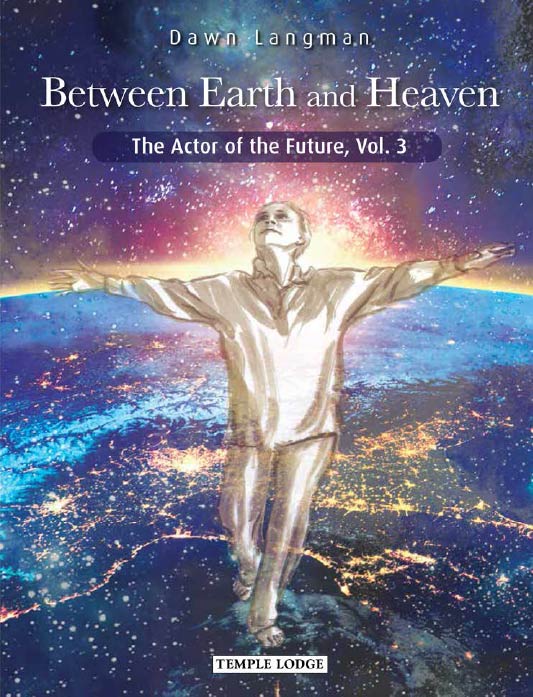
Between Earth and Heaven
The Actor of the Future, Vol.3by Dawn Langman
In this third volume in The Actor of the Future seried, Dawn Langman continues to explore the integration of Steiner’s research into speech, drama and eurythmy with Michael Chekhov’s acting methodology. Her advanced applications of all the basic processes allow the art of the actor and speaker to evolve beyond the ‘soul and body’ paradigm – still broadly accepted in contemporary culture – to include dimensions of the spirit. The book contains a seminal analysis of comedy and tragedy, showing how an understanding of their esoteric roots – sprung from the Eleusis mysteries of ancient Greece – deepen our appreciation and our ability to implement the practical suggestions made by Steiner and Chekhov to differentiate the fundamental styles. A comprehensive exploration of the vowels in relation to planetary beings lays the foundation for many layers of artistic deepening and application.
‘Dawn Langman gifts us with yet another magnificent contribution to her book series developing an integrated acting technique based on the indications of Rudolf Steiner and Michael Chekhov, in which actors become the work of art. Venturing even further into the deeper alchemical mysteries of the work, Langman leads us into an imagination of future theatre that includes a genuine experience of the I AM, the origin of comedy and tragedy, Dante’s Paradiso as example of how we can experience the planetary spheres in word and gesture, and much more, inspiring the unfoldment of actors of the future.’
- Dr Jane Gilmer, actress and teacher, author of The Alchemical Actor (2021) and former Assistant Professor of Drama, VPA, National Institute of Education, Singapore
‘In this present volume, Dawn Langman continues her in-depth exploration of the integration of Michael Chekhov’s system of psycho-physical awareness with Rudolf Steiner’s indications for creative speech and eurythmy. In so doing, she genuinely models both teachers’ emphasis on experimentation and exploration absent the dogmatism sometimes associated with such work. The careful, conscious communication of her own advanced exercises created to develop this new methodology will be most effective when worked in conjunction with her previous books, The Art of Acting, The Art of Speech and The Actor of the Future, Vols. 1 & 2. Taken as a whole, Langman reveals the degree of empathy and responsiveness possible not only between human beings, but with all the manifold community of beings “between earth and heaven.”'
- Dr Diane Caracciolo, Associate Professor of Educational Theatre, Adelphi University, USA
All books by Dawn Langman are available at:
Rudolf Steiner Bookshop (also stocks the DVDs)World of Books
Angus & Robertson
Dymocks
Booktopia
Amazon
DVDs
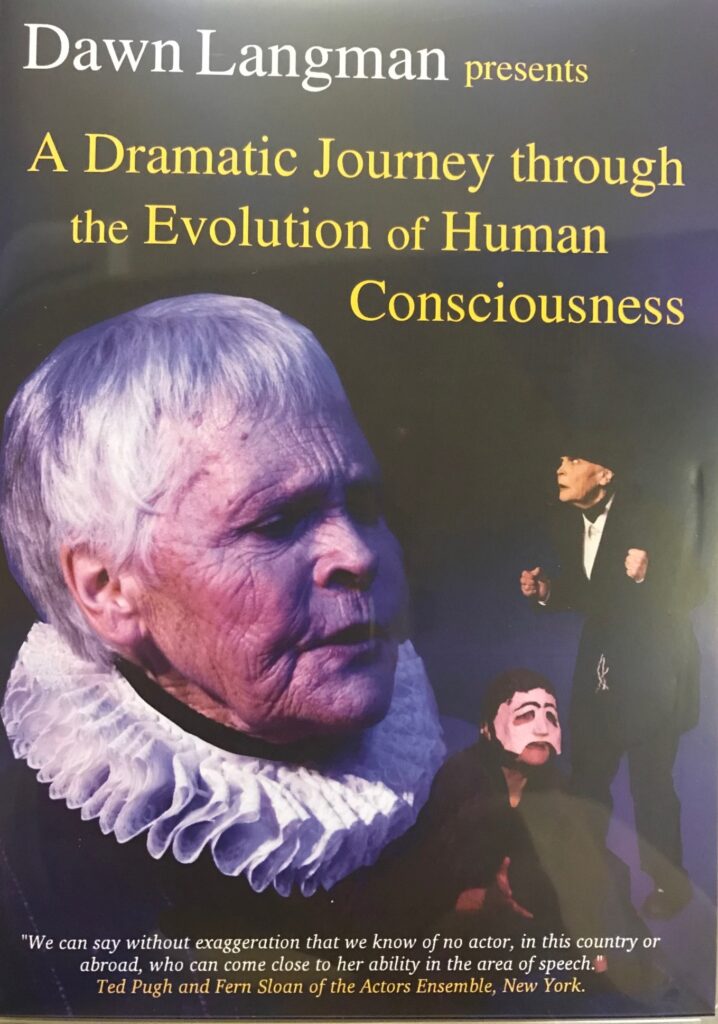
A Dramatic Journey through the Evolution of Human Consciousness
(3 DVDs only available as a box set).DVD 1
Human Being! Know Thyself: The birth of Greek drama out of the Mysteries of Eleusis.
Some key moments from Homer’s Iliad and Odyssey and from one of Plato’s dialogues reveal the transition taking place in Greek consciousness at the time when the drama was born. In scenes and moments from the tragedies Prometheus Bound, the Oedipus trilogy, the Orestes story, The Trojan Women, The Bacchae, and Aristophanes’ comedy The Frogs we shall explore aspects of initiation in the age of the intellectual soul.
DVD 2
The Place of the Skull: The journey to Self Knowledge from Shakespeare to Modern Times.
Beginning with a chorus from Euripides, Trojan Women we trace the trajectory of the gradual replacement of the old clairvoyant consciousness by the human intellect throughout the age of Kali Yuga. We will experience what happens as humanity enters the age of the consciousness soul when the intellect and heart are separated, as explored by Shakespeare in moments from his Midsummer Night’s Dream and Hamlet. We shall follow the fate of the rational intellect further through Goethe’s Faust, and into the nihilism of the twentieth century through scenes from Waiting for Godot and Peter Shaffer’s Equus which explore what happens when humanity faces the threshold with an intellect that on its own, cannot solve life’s questions. A scene from Jarry’s Ubu Roi contrasts the spiritual emptiness of many human beings at the end of the nineteenth century with the potential for our spiritual evolution revealed in Shakespeare’s characters. Moments from his final play: Henry VIII will give us a glimpse of Shakespeare’s prophetic vision of the spiritual journey that moves beyond the nadir of materialism.
DVD 3
‘The Fabulous wings unused’ *: humanity at the threshold.
‘Thank God our time is now when wrong comes up to face us everywhere’ *– recognising what it means for the modern human being to face the journey to self-knowledge. We begin with key moments from the great dramas written by Ibsen and Chekhov just around the year 1899, the date Steiner indicated as marking the end of Kali Yuga. We explore what happens when human beings continue to confront the threshold of the spiritual world unconsciously through dramas including Arthur Miller’s Death of a Salesman, Beckett’s Waiting for Godot and Edward Albee’s Who’s afraid of Virginia Woolf. Moments from Thornton Wilder’s Our Town and Tony Kushner’s Angels in America, point to the possibility of moving beyond the materialistic view implicit in the answer given by Oedipus, in the play by Sophocles, to the riddle posed by the sphynx as to the nature of the human being. In a groundbreaking scene from Steiner’s 2nd Mystery Drama, we witness the journey of a human being who evolves to cross the threshold consciously.
*Christopher Fry’s A Sleep of Prisoners